Thursday, November 5, 2015

First grade Picasso portraits


First Grade artists are studying the life and work of Pablo Picasso. 

1st grade artists learned about the art of Pablo Picasso. We read a book about him saw how his art changed from realistic to abstract. When he was a child, we was incredibly talented and painted very realistically. His life took many turns and he went through a Rose Period in his art, a Blue Period, and a Cubistic Period. Ask you students what his work looked like in these periods and why he developed each one! :) 

One day one, we used shapes to draw some side view facial features, and some front view features just like Picasso did. Then we reviewed warm and cool colors by painting one half warm and the other cool. 

On day 2, we learned a song called the "Picasso Polka" from the CD "Songs in the Key of Art." We had a lot of fun singing it while we worked as well!


On day three, we used a Venn Diagram to review the warm and cool colors and had students come up and place miniature artworks in the diagram depending on their color schemes.


For the backs of our artworks, we wrote out our learning goals on a sheet that had some Picasso art. Kids could even decorate the art if they wanted to:


On the final day, after singing the Picasso Polka, we used Mr. Potato Heads to create collaborative "Mr Picasso Heads!" They are heads with the parts all mixed up in a way that Picasso might have created them. Students had to work as a table group (of about 4-5 kids) to create their head as well as give him/her a silly name!


Learning Goals:
I can talk about the life and art of Pablo Picasso.
I can recognize his Blue Period, Rose Period and Cubist Periods.
I can distinguish between a side view portrait and a front view portrait.
I can use warm and cool colors.
I can create texture with a texture plate.

Second grade Henri Matisse fishbowls


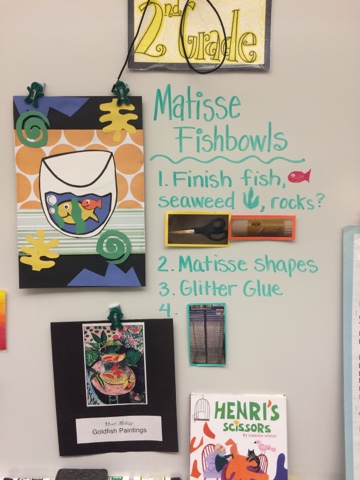
2nd grade artists are learning about the life and art of Henri Matisse.  We read the book "The Colorful Dreamer: The Story of Henri Matisse" as well as the book, "Henri's Scissors."After admiring many of Matisse's colorful works of art, we were inspired by his "Goldfish" art. We created our own collages and used some of Matisse's signature shapes. 

Image result for the colorful dreamer


Learning Goals:
I can discuss the life and art of Henri Matisse.
I can create a cut paper collage.
I can create some Matisse-like shapes.

Third Grade Mini Mona Lisas


Third grade artists are studying the life and art of Leonardo Da Vinci. They are learning about one of the most famous and widely recognized portraits in the whole world... the MONA LISA! We even learned that she was so popular that she was even stolen at one point! We read the book, "Who Stole the Mona Lisa?" and learned a bit more about her history. 


After reading, we practiced drawing her portrait (and landscape background) for ourselves! We practiced various coloring techniques with colored pencils such as: blending, layering and mixing. We practiced some calligraphy when writing her name for our projects. After assembling our mini-Monas in old silver Premier jewelry boxes, early finishers were able to do an Art Challenge: We challenged them to complete a portrait on a photocopy that included only Mona's face and hands. They used their imaginations to think up a setting, fashion, and theme for their version of the Mona. 


Learning Goals: 
I can talk about and write down 6 facts about the life and art of Leonardo Da Vinci.
I can draw a portrait like Mona Lisa.
I can draw a landscapes that shows space (things get smaller as they are further away).
I can use various coloring techniques in my art.
I can do some calligraphy with Mona Lisa's name

Fifth Grade Chihuly Collaborative Sculpture


5th grade artists are working on a collaborative project like Dale Chihuly!  We learned about his life, his installations and some of the work that he has displayed at our local Frederick Meijer Gardens! We watched a slide show about him and then began coloring water bottles with permanent markers in either warm or cold colors. 


On Day 2 of this project, we did a partner read out of the Scholastic Art Magazine about Dale Chihuly and chose our 2 favorite new facts to write down on a slip of paper for a prize drawing.


Learning Goals:
I can work collaboratively.
I can retell facts about Dale Chihuly's life and art.
I can explain the difference between form and shape.
I can distinguish between warm and cool colors.


Kindergarten Cartoon Expressions - The Five Little Pumpkins


Kindergarten artists read the book "The Five Little Pumpkins" and thought about the way that each pumpkin was feeling in the story. We looked at the way the illustrator showed those feelings by the way that he drew them. We recited the book's poem and acted out those emotions so that we could see and feel what our faces were doing when we looked surprised, scared, bored, sad, and happy. We drew these expressions on each of our pumpkins.


On the back, students wrote, "Cartoon Expressions" so that they could share with mom and dad what they were learning about and some even added the poem linked below:


Learning Goals: 
I can recognize what different facial expressions look like and make them with my own face.
I can draw like an illustrator.
I can draw 5 different cartoon expressions.

Tuesday, October 27, 2015

Fourth grade Edgar Dégas and Jackson Pollock figure drawing


Fourth grade artists reviewed the artist that they learned about last year, Jackson Pollock. We talked about how his art is abstract and is more about the action of painting than the representation of what is painted. We used his style of painting to be the background for our Edgar Degas figure drawing project. 

First, we had fun dripping paint onto our papers and then blowing through a straw to push and mix the paint around on our papers.


We also reviewed warm and cool color schemes by painting one half of the paper with each color group.


Next, we watched a movie about Edgar Degas and wrote down our favorite 5 or 6 facts on a bookmark to put on the backs of our artworks. They use these facts to share with their families what they have learned about this project when they get to bring it home. We had a few kids volunteer to model some poses for us to practice our figure drawing. We tried to focus on having poses that included diagonals so that we could see more movement in our artworks like Edgar Degas did.  


We carefully cut out our figure drawing silhouettes and glued them to our warm/cool papers.


On the back of the artwork, students wrote six facts that they knew about the artist.


Learning Goals:
I can recognize the art of Edgar Degas.
I can recognize the art of Jackson Pollock.
I can tell some facts about Degas and Pollock's life and art.
I can paint in the style of Pollock.
I can draw a human figure with the correct proportions.